


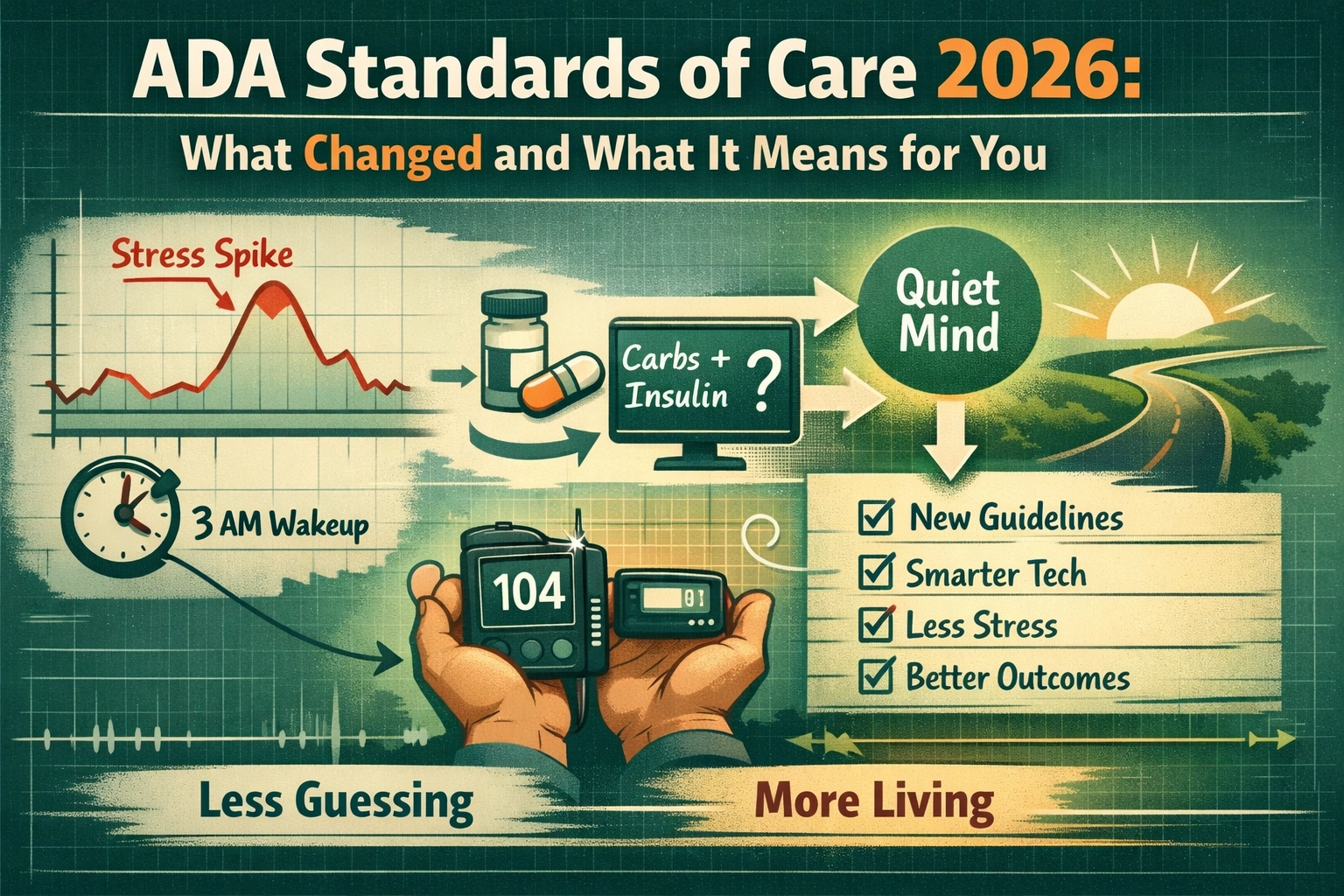
Every January, the American Diabetes Association (ADA) releases a document that dictates exactly how your medical care is handled. It’s called the Standards of Care in Diabetes. For most people living with Type 1, this 200-page clinical PDF is something your endocrinologist skims while you’re sitting on the crinkly paper of the exam table.
But you should care about it. This document is the "playbook" for insurance companies, doctors, and hospitals. If the ADA says a specific technology or screening is "Standard of Care," it becomes significantly harder for your insurance provider to tell you "no."
The 2026 updates represent one of the most aggressive shifts toward technology and mental health integration we have ever seen. The "Engineer" in me loves the data-driven tech mandates; the "Veteran" in me, who has lived with this for 18 years, is relieved to see the human element finally getting its due.
For decades, the medical establishment used a specific word to describe people who struggled with their numbers: Non-compliant.
It’s a word that feels like a slap in the face when you’ve stayed up until 3:00 AM treating a stubborn low or spent your entire afternoon fighting a "rage-bolus" spike. It implies a lack of will. It ignores the 180+ decisions you make every single day.
In the 2026 Standards, there is a definitive move away from this judgmental language. The ADA is now emphasizing "person-first" language and acknowledging that if a patient isn't meeting targets, the problem is likely the system or the tools: not the person’s character.
This isn't just about being polite. When the clinical guidelines stop blaming the patient, the conversation shifts toward finding better tools, like Automated Insulin Delivery (AID) systems or better data logging, rather than just telling you to "try harder."
The biggest headline for 2026 is that Continuous Glucose Monitoring (CGM) is now the absolute standard of care for all individuals with Type 1 Diabetes, regardless of age or "success" with finger sticks.
In previous years, you often had to prove you were "bad enough" at managing your diabetes (frequent lows, high A1C) to qualify for a CGM. The 2026 guidelines flip that logic. The ADA now recognizes that a CGM is a fundamental safety tool, not a reward for poor control.
Key takeaways for your next appointment:

The "Invisible Load" of T1D is finally being quantified. The 2026 guidelines mandate annual anxiety screening for everyone with diabetes.
If you’ve ever felt your heart race when you see a downward arrow on your Dexcom, or if you’ve avoided going to sleep because you’re terrified of a nocturnal low, you know that "Fear of Hypoglycemia" is a clinical reality. For the first time, the ADA is recommending annual screenings specifically for this fear in high-risk individuals.
For parents, the news is even more significant: psychosocial screening: including checks for diabetes distress, depression, and disordered eating: is now recommended to start as early as ages 7-8.
At Subseven, we’ve always believed that the goal isn’t just a flat line on a graph; it’s a quiet mind. Seeing the ADA acknowledge that mental health is a core pillar of diabetes management: not just a side effect: is a massive win for the community.
The Engineer’s dream is a closed loop that works so well you can forget you have a pancreas. We aren't fully there yet, but the 2026 standards bring us closer.
The new guidelines recommend that Automated Insulin Delivery (AID) systems: like Tandem Control-IQ, Omnipod 5, or the iLet Bionic Pancreas: should be offered to almost everyone with T1D as soon as they are diagnosed.
The data is undeniable: AID systems reduce the cognitive load and increase Time in Range (TIR) far more effectively than manual injections for the vast majority of people. If your doctor is still pushing "MDI first" as a rite of passage for the newly diagnosed, they are now officially behind the ADA’s 2026 recommendations.
The A1C is a blunt instrument. It’s an average of three months that hides the "peaks and valleys" of daily life. You can have a "perfect" 6.5% A1C but be swinging from 40 mg/dL to 300 mg/dL every single day.
The 2026 standards continue to push Time in Range (TIR) as the gold standard.
This shift allows you to have a more honest conversation with your endo. Instead of "Your A1C is up," the conversation becomes "Your TIR is 55% because you're spiking every day at 2 PM. Let's look at the data and fix that specific window."

Knowing the guidelines is your greatest self-advocacy tool. You don't need to be a doctor to walk into your endo's office and ask for what the ADA says you deserve.
Here is your checklist for your next 15-minute appointment:
The 2026 ADA Standards are finally catching up to a reality we’ve known for a long time: Diabetes is a data problem, not a character problem.
By emphasizing CGM access, AID systems, and mental health screenings, the medical community is acknowledging that we need tools that do the heavy lifting for us. Willpower is a finite resource. You only have so much "give a damn" to spend every day.
Every time the ADA moves toward automation and away from manual "compliance," it validates our mission. We build tools like Subseven to bridge the gap between these clinical guidelines and your real life. We want to take the "stressing and guessing" out of the equation so that the 180 decisions you make today feel like zero.
You are allowed to walk into your doctor’s office knowing exactly what the standard of care is. You are the CEO of your own health. The ADA just gave you a better manual: now it’s time to use it.
If you’re looking for a way to track the "hidden variables" that the ADA is finally starting to talk about: like stress, exercise timing, and burnout: check out how Subseven integrates with your existing tech to give you the full picture.


