


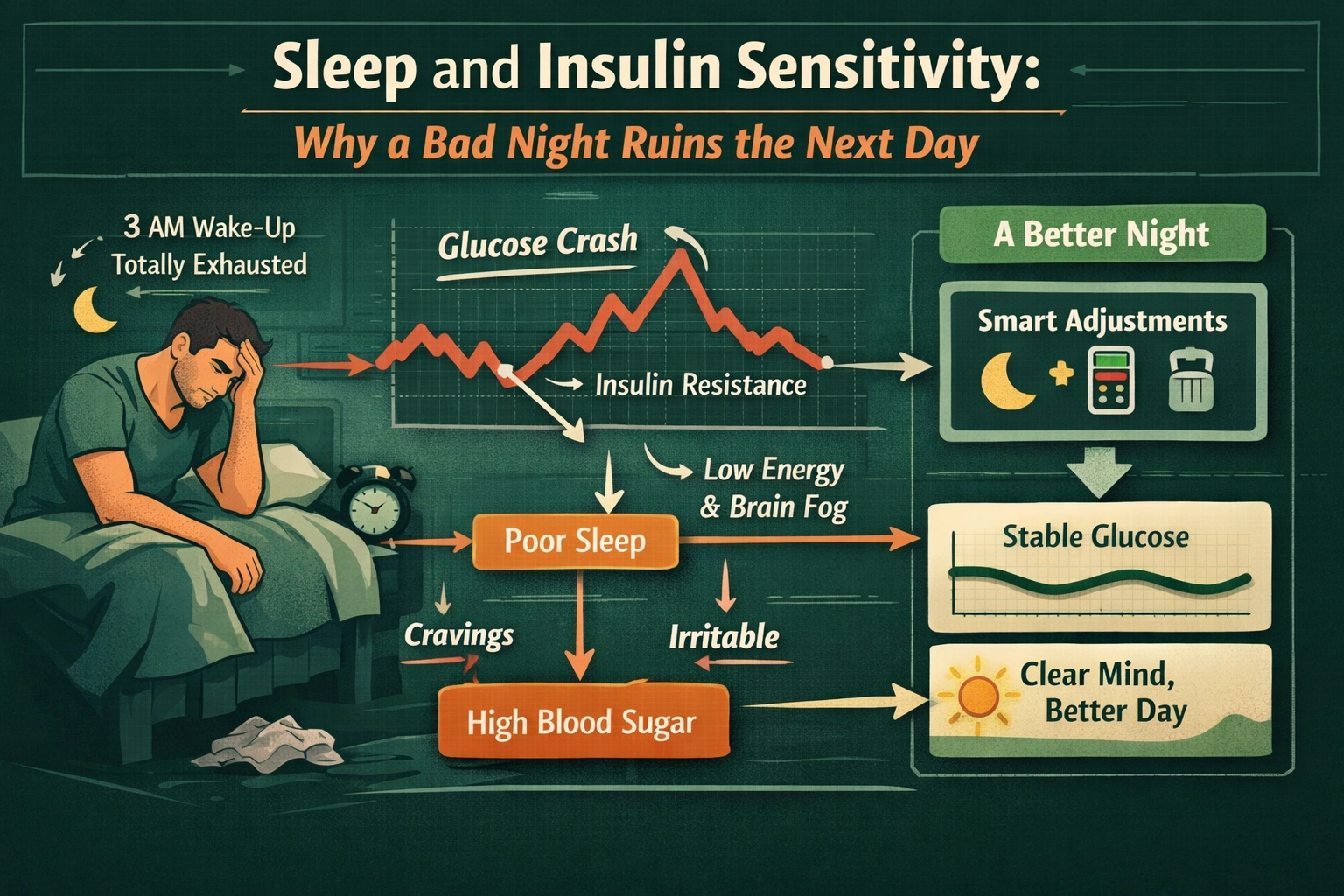
You wake up feeling like you’ve been hit by a truck. The alarm goes off, and your head is pounding, your eyes are gritty, and your first thought isn’t "What’s for breakfast?", it’s "What is my blood sugar doing?" You check your CGM. You’re sitting at 240 mg/dL, despite eating a low-carb dinner and bolusing perfectly. You didn't even eat a midnight snack.
This is the "zombie day" reality of Type 1 Diabetes. We’ve all been there. You do everything right, but because you tossed and turned for six hours, your body has decided to play by a different set of rules today. It feels like total chaos.
BLUF: Does sleep affect blood sugar? Absolutely. Research shows that just one night of partial sleep deprivation (less than six hours) can reduce your insulin sensitivity by 20% to 30%. This happens because poor sleep triggers a spike in stress hormones like cortisol, which tells your liver to dump extra glucose into your blood while simultaneously making your cells "deaf" to the insulin you’re injecting.
When we talk about T1D, we usually focus on the "Big Two": carbs and insulin. But when you’re sleep-deprived, those two variables stay the same while the environment they operate in completely shifts.
Think of your insulin as a key and your cells as a door. On a good night’s sleep, the key turns easily. But after a bad night, it’s like someone shoved gum into the lock. You have to push harder, use more force (more insulin), and even then, the door might not budge.
This creates a "Double Whammy" effect:
It’s an infuriating cycle. You’re high because your liver is dumping sugar, and you stay high because your muscles won't take it in. It's not your fault; it’s biology.

We need to talk about the "Stress Hormone Cocktail." When we don't get enough deep sleep, our body enters a state of physiological stress. Even if you don't feel stressed mentally, your biology thinks you're in a fight-or-flight situation.
Your body releases cortisol and epinephrine (adrenaline). These hormones are designed to give you energy to run away from a tiger. They do this by dumping sugar into the bloodstream and temporarily shutting down "non-essential" functions, like responding to insulin.
For someone without T1D, their pancreas just pumps out more insulin to cover the spike. For us? We have to do the manual math. But how do you calculate for a 20% drop in sensitivity when you’re already in a "brain fog" from lack of sleep?
There’s also a hidden player: Metabolic Endotoxemia. Research suggests that sleep restriction can actually increase gut permeability. This triggers low-level inflammation (measured by markers like C-reactive protein), which further drives insulin resistance. It’s a systemic breakdown that starts in the brain and ends in the gut, leaving your blood sugar caught in the crossfire.
The cruelest part of T1D is that it’s a self-perpetuating cycle.
This isn't just a bad day; it’s an invisible load that people without T1D never see. We aren't just managing a disease; we’re managing a 24/7 biological balancing act that requires us to be "on" even when our brains are screaming for rest.
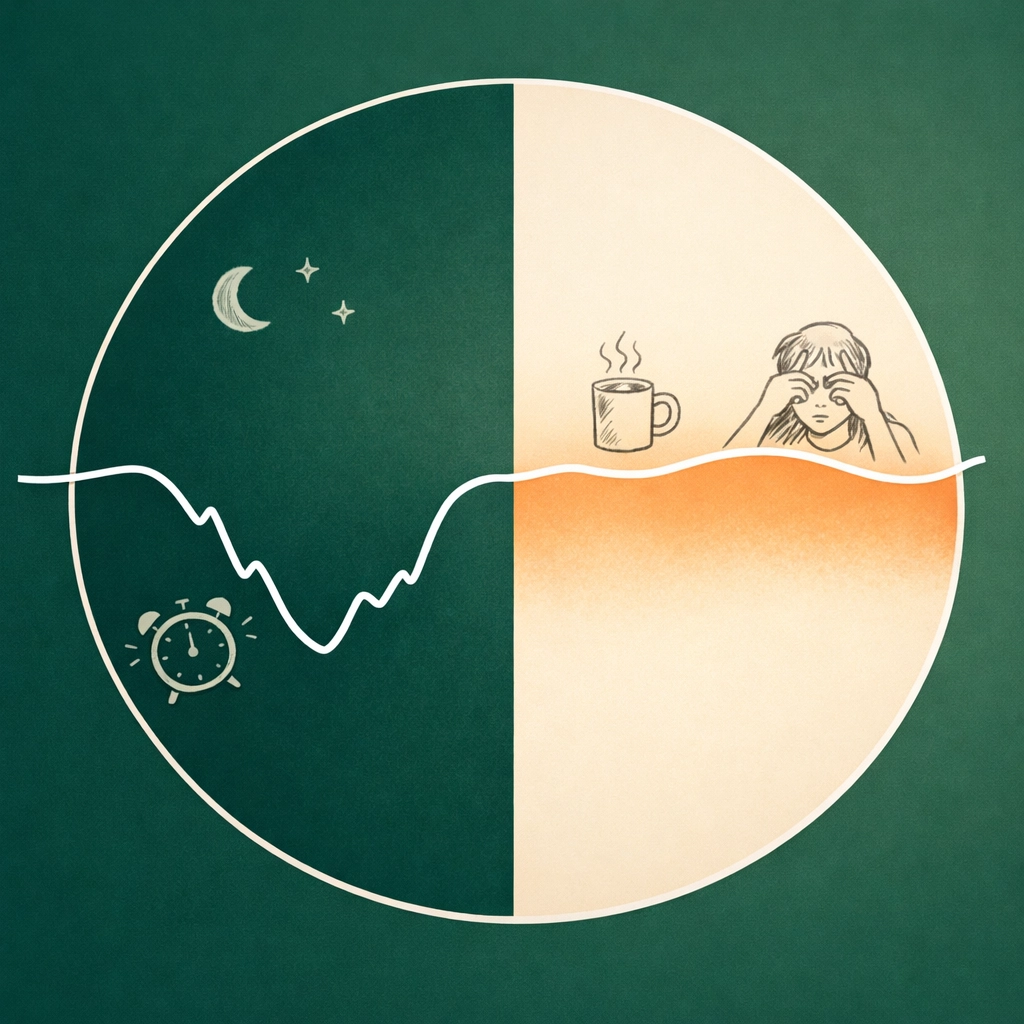
It’s not just the biology; it's the behavior. Sleep deprivation hits the frontal cortex of the brain, the part responsible for impulse control and decision-making.
When you’re exhausted, your body produces more ghrelin (the hunger hormone) and less leptin (the fullness hormone). You find yourself reaching for high-carb, high-sugar snacks because your brain is desperately seeking a quick hit of energy to stay awake.
In a T1D context, this is a recipe for disaster. You’re already 30% more resistant to insulin, and now you’re craving a bagel or a sugary latte. It’s like trying to put out a fire with a squirt gun while someone else is pouring gasoline on the back of the house.
First, give yourself some grace. Stop beating yourself up for the high numbers. If you know you slept poorly, acknowledge that your "standard" insulin-to-carb ratios might not work today.
Here are a few ways to navigate the "Zombie Day":
Type 1 Diabetes feels like guesswork because we’re often missing half the data. We have the CGM line and the insulin pump history, but we don't always see the why behind the fluctuations.
The goal isn't to achieve "perfect sleep." Between the 2 AM alarms and the general stress of life, perfection is a fairy tale. The goal is pattern recognition.
When you begin to understand that a bad night of sleep is a "hidden variable" just as real as a bowl of pasta, the frustration starts to fade. You stop asking "What did I do wrong?" and start saying "Ah, I see what's happening here."
At Subseven, this is exactly what we’re building for. We believe that by tracking these hidden variables, like sleep, stress, and hormones, we can take the "guesswork" out of the equation. We’re moving toward a world where the system understands your "Zombie Day" before you even have your first cup of coffee.
You’re doing a hard thing. Don't let a bad night's sleep make you feel like you're failing. You're just navigating a complex system with a few missing pieces of information. Let’s start filling in the blanks.
1. Does one bad night of sleep really matter for blood sugar?
Yes. Studies show that even a single night of restricted sleep (4 hours) can reduce peripheral insulin sensitivity by 25%. It’s an immediate biological response, not just a long-term risk.
2. Why am I high in the morning even if I didn't eat?
This is often the "Dawn Phenomenon" or "Feet on Floor" effect, caused by the release of growth hormones and cortisol as your body prepares to wake up. Poor sleep quality can amplify these hormone dumps, leading to higher fasting numbers.
3. Does sleep apnea affect Type 1 Diabetes?
Absolutely. Sleep apnea causes repeated oxygen drops and "micro-awakenings" throughout the night. This puts the body in a state of chronic stress, leading to sustained insulin resistance and higher A1C levels over time.
4. How much sleep do I actually need for good blood sugar?
While everyone is different, most research points to 7–8 hours as the "sweet spot" for metabolic health. Sleeping less than 6 hours is consistently linked to increased insulin resistance.
5. Can extra sleep "fix" my insulin sensitivity?
"Recovery sleep" can help, but it’s not an instant fix. It can take a couple of nights of solid rest for your hormone levels (like cortisol and CRP) to return to baseline and for your insulin sensitivity to fully recover.
6. Why does my blood sugar drop when I finally fall into a deep sleep?
During deep sleep (REM and slow-wave), your body’s glucose demands change. If you have too much basal insulin in your system, you may experience a drop. This is why consistent tracking is vital: it helps you balance your needs across different sleep stages.
Author Bio:
Chris Putsch is the CEO and Founder of Subseven. Having lived with Type 1 Diabetes for decades, he is on a mission to move diabetes management from manual "math and guesswork" to automated, data-driven patterns. He builds tools that help people with T1D reclaim their mental bandwidth and live with more freedom.


