


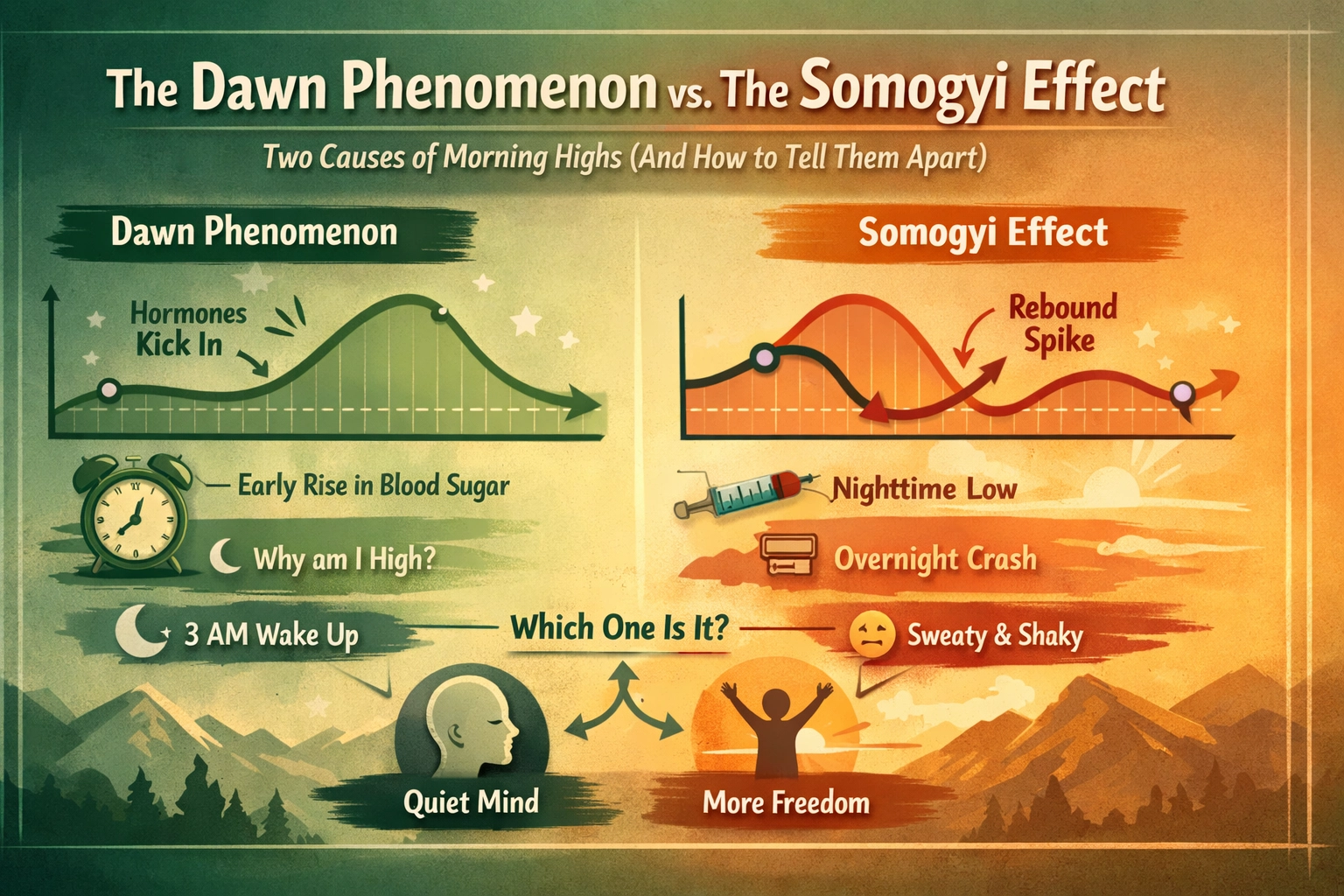
Waking up with a high blood sugar reading is the ultimate form of Type 1 Diabetes gaslighting.
You did everything right. You counted every carb at dinner. You didn't snack before bed. Your basal rate is dialed in. You went to sleep with a perfect 110 mg/dL and a flat arrow. Then, you wake up at 7:00 AM, check your CGM, and you’re staring at a 215.
It feels like a personal failure. It feels like your body is working against you while you’re literally unconscious.
This isn't a character flaw. It’s biology. Specifically, it’s likely one of two things: the Dawn Phenomenon or the Somogyi Effect. While both end with a high morning number, they start for opposite reasons. If you treat the wrong one, you’ll only make the problem worse.
As someone living with T1D for 18 years, I know the 7:00 AM rage well. It’s that feeling of being behind before the day has even started. You haven't even had coffee yet, and you're already calculating a correction dose and wondering if you should skip breakfast.
The mental load of T1D is heavy enough during the day when you're awake to manage it. But when your numbers go rogue while you're sleeping, it adds a layer of exhaustion that's hard to explain to people who don't live it. It’s the "invisible load": the 3:00 AM anxiety and the frustration of unexplained variables.
To fix the morning high, we have to stop guessing and start looking at the math.
The Dawn Phenomenon is a natural, physiological process. Every human being experiences it, whether they have diabetes or not.
Between 2:00 AM and 8:00 AM, your body prepares to wake up. It releases a cocktail of "counter-regulatory" hormones, including:
In a person without T1D, the pancreas senses this rise in glucose and releases a corresponding amount of insulin to keep things level. In our case, the liver dumps the sugar, but the insulin isn't there to meet it. The result is a steady climb in blood sugar that starts in the early morning hours and peaks right as you open your eyes.
It’s essentially your body trying to give you a "boost" of energy to start the day, but without the key (insulin) to use that energy, the sugar just sits in your bloodstream.
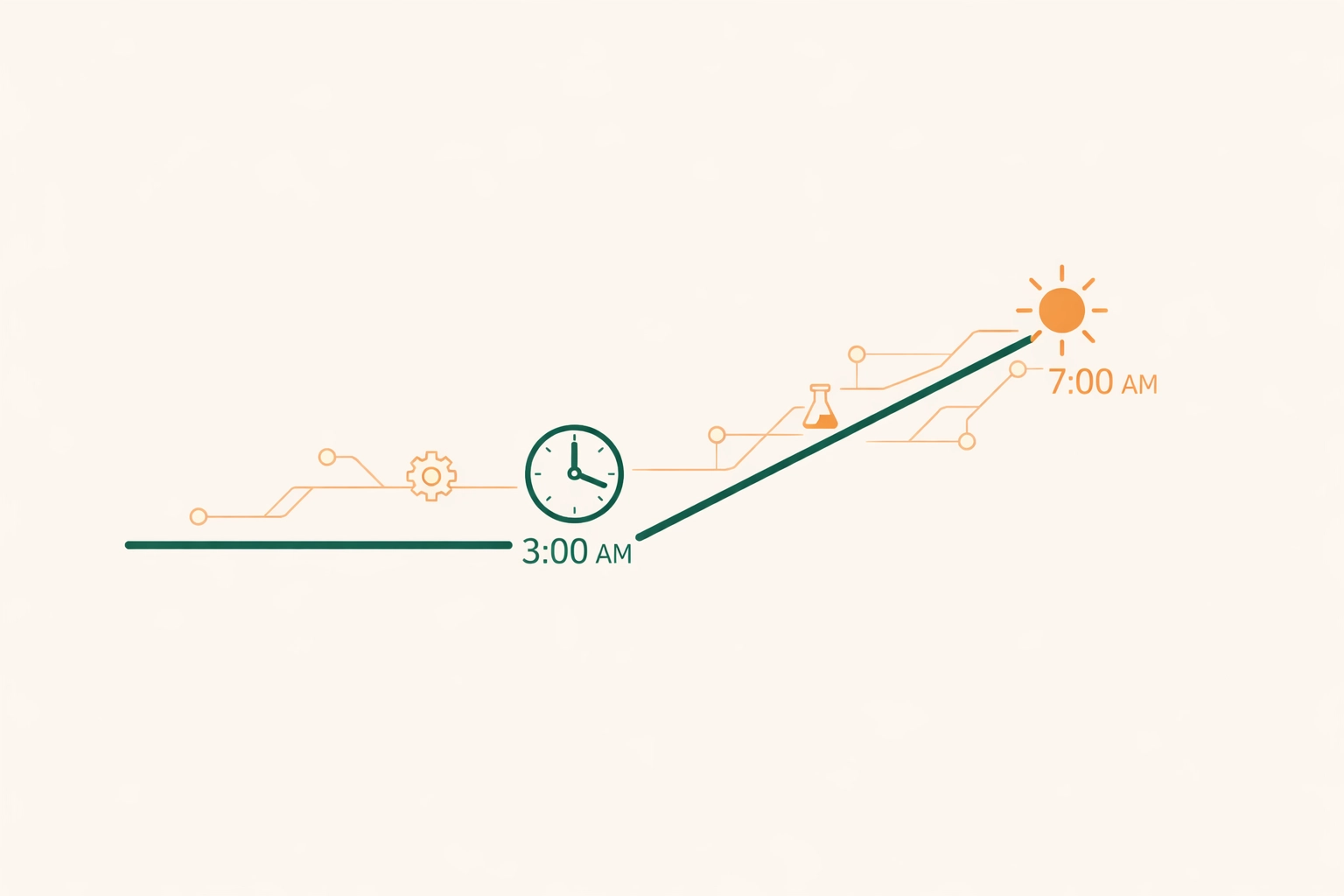
Description: A clean, engineer-style chart showing a steady rise in blood glucose starting at 3 AM and peaking at 7 AM, labeled "The Dawn Phenomenon."
The Somogyi Effect: also known as rebound hyperglycemia: is a different beast entirely. It’s a defensive maneuver by your body that overshoots the target.
Named after Dr. Michael Somogyi, this theory suggests that if your blood sugar drops too low in the middle of the night (nocturnal hypoglycemia), your body panics. It perceives the low as a life-threatening event and triggers a massive release of those same counter-regulatory hormones to save you.
The liver dumps glucose to raise your levels, but it usually dumps way too much. By the time you wake up, your blood sugar has skyrocketed as a result of that "rebound."
The Somogyi Effect is essentially a "bounce back" from a low you might not have even felt.
Here is where the engineering of T1D gets tricky.
If you have the Dawn Phenomenon, the solution is usually more insulin (increasing your basal rate in the early morning hours).
If you have the Somogyi Effect, the cause is too much insulin at night. The solution is usually less insulin (decreasing your basal rate or eating a bedtime snack) to prevent the initial low.
If you misdiagnose yourself and increase your insulin to "fix" a Somogyi Effect, you will drive yourself even lower at 2:00 AM, causing an even bigger rebound high at 7:00 AM. You’ll be stuck in a dangerous cycle of lows and highs that feels impossible to break.

Description: A flowchart showing two paths: Path A (Low at 3 AM -> High at 7 AM = Somogyi) and Path B (Steady/High at 3 AM -> Higher at 7 AM = Dawn Phenomenon).
To solve the mystery, you have to know what’s happening while you’re dead to the world. There is only one way to do this: you need data from the middle of the night.
If you use a Continuous Glucose Monitor (CGM), this is much easier. You can simply scroll back through your overnight graph. If you don't have a CGM, you'll have to do it the old-fashioned way: set an alarm for 3:00 AM and do a finger stick.
The Diagnostic Criteria:
If you are low at 3:00 AM and high in the morning, it’s the Somogyi Effect. Your body is rebounding from a nocturnal low.
If you are normal or high at 3:00 AM and even higher in the morning, it’s the Dawn Phenomenon. Your body is simply outrunning your basal insulin.
Once you’ve identified the culprit, you can move from stressing to strategizing.
For the Dawn Phenomenon:
For the Somogyi Effect:
The reality of T1D is that your body is a dynamic system. What worked last month might not work this month. Stress, illness, and even changes in your workout routine can shift the timing of your hormones.
This is why pattern recognition is the most powerful tool in your kit.
At Subseven, we believe that you shouldn't have to be a professional data scientist just to wake up with a normal blood sugar. The goal of modern diabetes management isn't just a lower A1C; it’s a quiet mind. It’s knowing why something happened so you can fix it and move on with your life.
When you stop viewing a morning 250 as a failure and start viewing it as a data point, the emotional weight of the disease begins to lift. You aren't "bad at diabetes." You’re just managing a complex biological engine that occasionally needs a tune-up.
Next time you wake up high, don't rage-bolus and move on. Look at the graph. Check the 3:00 AM mark. Find the pattern. Once you see the "why," the "how" becomes easy.
Take the stressing and guessing out of it. You’ve got enough to do today.


