


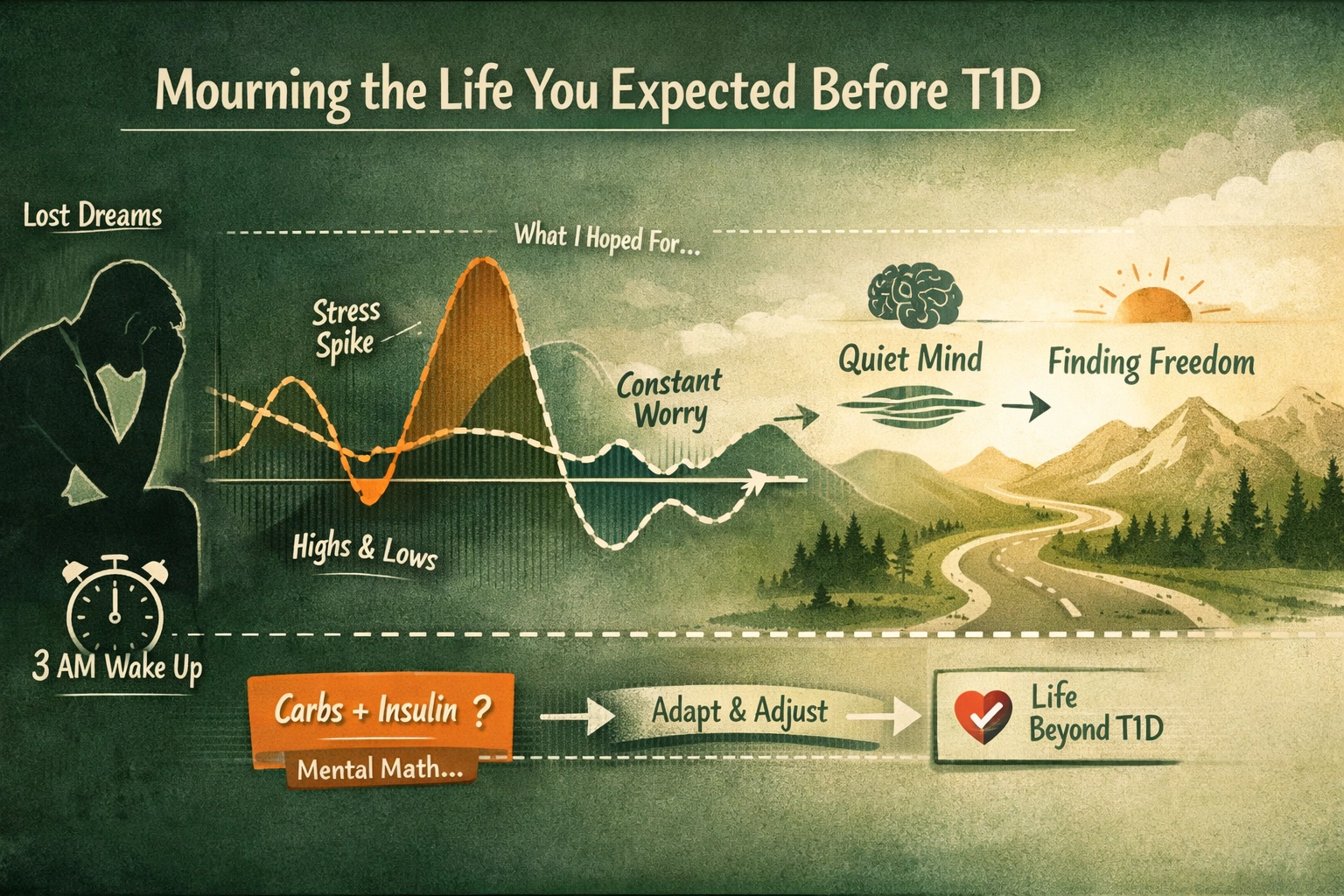
Grief in Type 1 Diabetes (T1D) is the deep, often unspoken mourning for the life you had, or the one you expected, before diagnosis. It’s not just about blood sugar; it’s about the loss of spontaneity, the end of "thoughtless" eating, and the permanent weight of the mental load. Recognizing this as legitimate grief is the first step toward true T1D mental health and coming to terms with T1D. It’s okay to miss your old self while managing your new reality. We are all grieving the version of ourselves that didn't need a kit to stay alive.
Let’s be real: diagnosis is a dividing line. There is the "Before You" and the "After You."
The "Before You" could go for a run on a whim. They could eat a slice of pizza at a party without doing a three-variable calculus equation in their head. They could sleep through the night without an alarm screaming that their sugar is 55 and dropping.
When T1D enters the room, that person effectively disappears.
It feels like being handed a permanent, unpaid, high-stakes internship that you never applied for and can never quit. You didn't just lose a working pancreas; you lost the ability to exist in the background of your own life. Now, you are always on. Always calculating. Always carrying the "backpack" of supplies, literal and metaphorical.

I hear this a lot: "I’ve had this for ten years, why am I still so pissed off about it?"
The answer is something researchers call chronic sorrow. Unlike the grief of losing a loved one, which typically follows a trajectory toward healing, T1D grief is a loop. It’s sustained but intermittent. It resurfaces every time you hit a "critical" moment.
Maybe it’s a big promotion at work, but instead of celebrating, you’re stressed because the extra pressure is making your basal rates look like a mountain range. Maybe it’s watching your friends travel light while you’re packing a separate suitcase just for insulin and sensors.
These moments trigger the grief all over again. It’s not that you haven't "accepted" the disease; it’s that the disease keeps taking things from you. Feeling angry, frustrated, or just plain over it isn't a sign that you’re failing. It’s a sign that you’re paying attention. It is a completely normal response to an abnormal situation.
When we talk about the emotional side of diabetes, we usually focus on the "burnout." But burnout is the exhaustion; grief is the source. We are mourning specific, tangible freedoms:
This is heavy stuff. If we don’t name it as grief, we just call it "stress." And stress is something you’re expected to "manage." Grief is something you have to feel.

This is a crucial distinction. In the medical world, doctors are quick to screen for depression. And yes, people with T1D are statistically more likely to experience clinical depression.
But often, what we’re feeling is Diabetes Distress.
Depression is a blanket of heaviness that covers everything. T1D grief is specific. You might feel totally fine and happy about your career, your relationships, and your hobbies, but feel a deep, stabbing sense of loss when you look at your CGM graph.
You can be a high-functioning, "successful" diabetic and still be mourning. You can have a 6.2 A1C and still want to scream at the sky because this is all so much work. Understanding that this is grief allows you to be gentler with yourself. You aren't "depressed" because you’re weak; you're grieving because you’re carrying a heavy load.
Toxic positivity is a plague in the chronic illness community. "It could be worse!" or "At least it’s manageable!"
WTF does "manageable" even mean? Building a rocket ship is manageable if you’re an aerospace engineer with a billion-dollar budget. That doesn't make it easy to do every single day while you're trying to raise a family and hold down a job.
When people tell us to "be positive," they are usually trying to make themselves feel better because our reality is uncomfortable for them. It silences the grief. It makes us feel like we have to hide the "messy" parts of T1D to be a "good" patient.
At Subseven, we believe the opposite. We think you have to acknowledge that it sucks before you can actually deal with it. You don't have to be relentlessly positive. You just have to be honest. Once you admit that the math is hard and the emotional toll is real, you can stop wasting energy pretending it’s not.

So, how do we get to the other side?
The truth is, there isn't really an "other side." There is just integration. Acceptance doesn't mean you like having T1D. It doesn't even mean you’ve stopped missing your old life.
Acceptance is saying: "This is mine. It’s part of my story now. It’s a giant pain in the ass, but I’m going to live a big, loud, messy life anyway."
The goal is to move from frustration (why is this happening?) to understanding (okay, this is happening because of X) to empowerment (I have the tools to handle X).
This is why we built Subseven. We can't take away the grief. We can't give you back your working beta cells. But we can take some of the work off your plate. If we can automate the "guessing and stressing," we can give you back a few more minutes of that spontaneity you miss. We can make the backpack feel a little lighter so you have more room to just... be.
You don’t have to do this perfectly. You don’t have to be a T1D superhero. You just have to keep showing up. And on the days when the grief feels too heavy, remember: you’re not alone in it. We’re all carrying the same bag.
1. How long does T1D grief last?
There is no expiration date. Because T1D is a "chronic sorrow," the grief tends to ebb and flow. You might go months feeling fine, only to have it resurface during a period of high stress or when facing a new complication.
2. Can parents experience this grief too?
Absolutely. In fact, parents often experience a profound "secondary grief" for the childhood they envisioned for their child. It is vital for parents to seek support and recognize their feelings as legitimate.
3. Is there a difference between T1D burnout and T1D grief?
Yes. Burnout is the physical and mental exhaustion resulting from the relentless tasks of management. Grief is the emotional response to the loss of health, spontaneity, and the pre-diagnosis version of life.
4. Does grieving mean I’m failing at my diabetes management?
Not at all. Your emotional state and your clinical management are two different things. Many people with excellent T1D control still experience deep feelings of loss.
5. How can I talk to my family about this?
Start by naming it. Instead of saying "I’m stressed," try saying "I’m feeling the weight of this disease today." Use metaphors to help them understand the invisible mental load you're carrying.
6. Is there a "right" way to come to terms with T1D?
The only "right" way is the way that works for you. For some, it’s finding community. For others, it’s using technology to automate the burden. The first step is always acknowledging that the loss is real.
About the Author:
Chris Putsch is the CEO and Founder of Subseven. Living with Type 1 Diabetes himself, Chris has spent years navigating the intersection of data, engineering, and the human experience. He built Subseven to help others in the T1D community move past the "guessing and stressing" and get back to living their lives.
Ready to lighten the load? Download Subseven and start automating the patterns in your T1D journey.


