


If you’ve lived with Type 1 Diabetes (T1D) for more than ten minutes, you know the "Math Tax." It’s the invisible fee we pay on every single meal. Look at the plate. Estimate the carbs. Guess the fiber. Check the fat. Factor in the walk you took two hours ago. It is exhausting. The iLet Bionic Pancreas is the first FDA-cleared automated insulin delivery (AID) system that promises to audit that tax for you. It requires no carb counting, no basal rates, and no correction factors. You give it your body weight, tell it if your meal is "Small," "Medium," or "Large," and let the algorithm do the rest. It is a radical departure from traditional pumping, designed to reduce the cognitive load of T1D.
Let’s be real for a second. We’ve all had those moments where we stare at a plate of Pad Thai and just think, "WTF do I do with this?"
You guess 60 grams. You spike to 240. You guess 80 grams. You crash at midnight. The manual labor of T1D management is a second full-time job that none of us applied for. Most closed-loop insulin delivery systems, like Tandem’s Control-IQ or Omnipod 5, are "hybrid" systems. They do a lot of the heavy lifting, but they still need you to be the pilot. You still have to tell them exactly how many carbs are in that sandwich.
The iLet Bionic Pancreas is different. It’s what the industry calls a "fully" closed-loop system (though in reality, we aren't quite at the 'set it and forget it' finish line yet). The big headline? You don’t enter numbers. You don’t set a basal rate. You don't calculate an insulin-to-carb ratio.

As an engineer, I love the simplicity of the iLet’s logic, even if it feels a little scary to hand over that much control.
When you start the iLet, the only piece of data it asks for is your body weight. That’s it. From that single number, the algorithm estimates your total daily dose. Once it starts, it uses your Dexcom or Libre 3 readings to adjust your insulin every five minutes.
But here is where it gets interesting: the "Meal Announcement." Instead of counting 42 grams of carbs, you tap a button on the screen that says "Medium."
The system learns your patterns over time. If a "Medium" meal usually requires more insulin for your body, the algorithm adapts. It’s essentially a machine-learning model strapped to your hip. It’s not looking for you to be "right" about the carbs; it’s looking to see how your body reacts to your version of a "Normal" meal.
If you are a "Type A" manager who loves tweaking your basal rates by 0.05 units at 3:00 AM to achieve a perfect flat line, the iLet might drive you crazy. It doesn't allow for that kind of micro-management.
However, for a huge segment of our community, this is a game-changer:

If you’re shopping for a new pump in 2026, the landscape is crowded. Here is how the iLet stacks up against the "Big Three":
The iLet is the "Automatic Transmission" of the diabetes world. Other pumps are "Manual" or "Paddle Shifters." You might get better performance out of a manual if you’re a pro driver, but for most people, the automatic just makes life easier.
We need to talk about the "Bionic" part of the name. It sounds like science fiction, like we’re becoming cyborgs who don't have to worry about blood sugar anymore.
But T1D is still chaos.
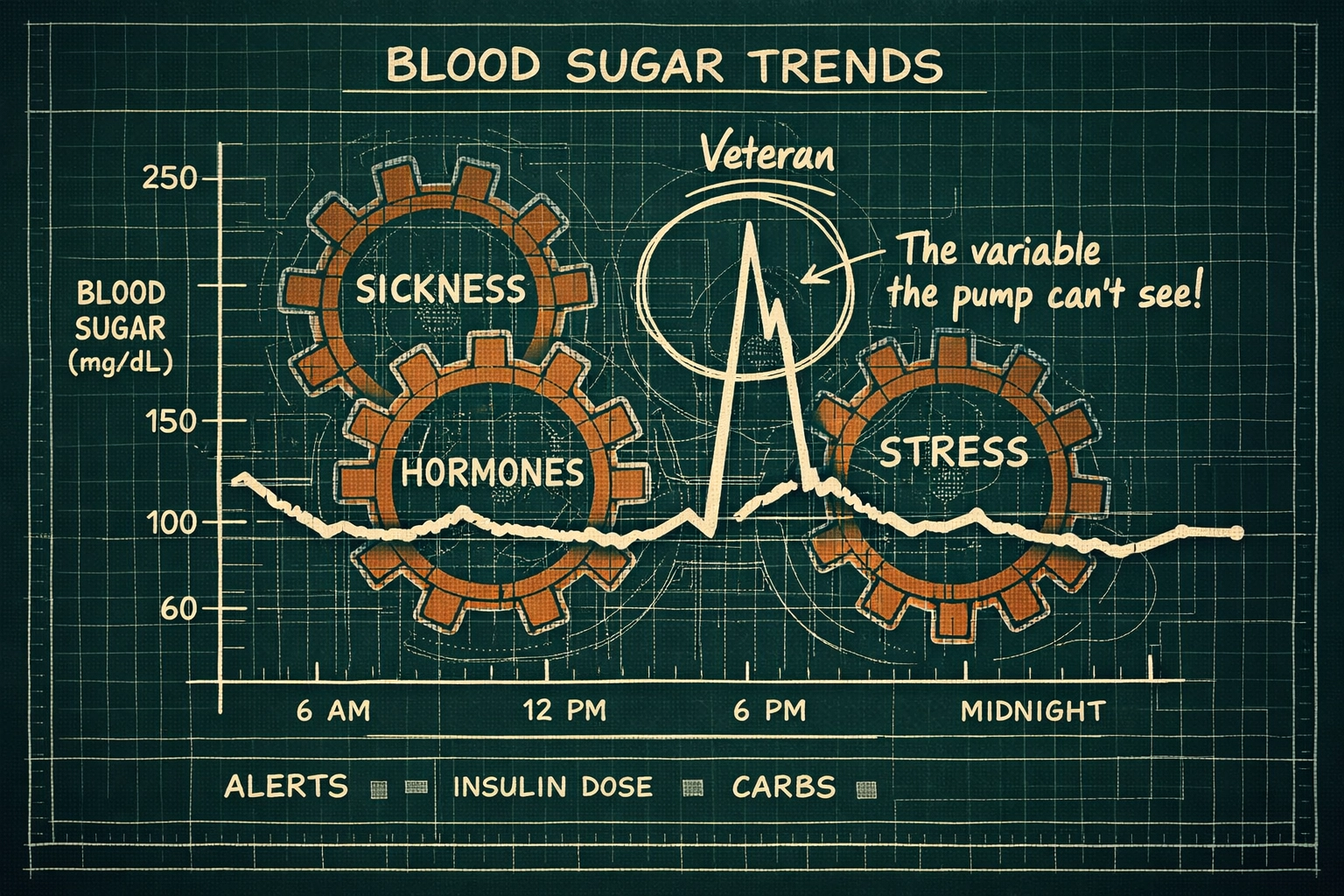
Even with a bionic pancreas, hidden variables still exist. The iLet doesn't know you’re about to get a flu. It doesn't know you’re stressed about a presentation. It doesn't know that "Medium" meal was actually a bowl of deep-fried Oreos that will hit your bloodstream four hours later.
The iLet can handle the insulin delivery, but it can’t handle the context. If you see a spike on the iLet, you can't just give yourself a manual correction bolus. You have to trust the system to see the high and fix it. For many long-term T1Ds, that "trust" is the hardest part to develop. We’ve spent years being told that we are the only ones who can keep ourselves safe. Handing that over to an algorithm feels like jumping out of a plane and hoping the parachute opens.
This is exactly why we built Subseven.
Whether you are using an iLet, an Omnipod, or a DIY Loop system, your data only tells half the story. The iLet sees a 250 mg/dL and starts cranking out insulin. What it doesn't see is that you’re 250 because you’re sitting in back-to-back meetings and haven't moved in four hours.
Automation is the future. It beats willpower every single time. But automation works best when you understand the patterns behind the decisions. When you use a tool like Subseven to log the "why", the stress, the movement, the sleep quality, you start to see the gaps where even the best bionic system might need a little help.
The goal isn't just a flat line on a CGM. It's a quiet mind. It's the ability to go out to dinner and talk to your friends instead of doing algebra under the table. The iLet is a massive step toward that freedom.

Does the iLet work with any CGM?
Currently, the iLet is integrated with the Dexcom G6 and G7, and it has recently added compatibility with the FreeStyle Libre 3 Plus. Always check the latest compatibility list before switching.
Can I still give a manual correction?
No. The iLet is designed to handle all dosing. If you are high, the system will recognize it and increase your micro-doses of insulin. You cannot "override" the system with a manual bolus.
What happens if I lose my CGM signal?
If the CGM signal is lost, the iLet reverts to a "safety basal" based on your weight until the connection is restored. It cannot provide automated dosing without real-time glucose data.
Is it covered by insurance?
Most major private insurance plans and Medicare cover the iLet, but because it is a newer technology, it's always best to have your doctor’s office run a benefits check.
Can I use it if I’m pregnant?
Currently, the iLet is cleared for people 6 years and older with T1D, but it has not been specifically cleared for use during pregnancy. You should discuss this with your high-risk OB and endocrinologist.
How often do I have to change the cartridge?
Like most tubed pumps, the reservoir typically needs to be changed every 2 to 3 days, depending on your total daily insulin requirements.
About the Author: Chris Putsch is the Founder of Subseven and has lived with Type 1 Diabetes for 18 years. He is an engineer by trade and a patient advocate by necessity, dedicated to building tools that take the "stressing and guessing" out of diabetes management.


