

I still remember the smell of the hospital room 18 years ago. It’s a specific mix of industrial floor cleaner and fear.
The doctor handed me a vial of insulin, a handful of syringes, and a stack of paper logs. He told me my life was going to be different now. He was right, but he didn’t tell me how it would be different 10, 15, or 20 years down the line.
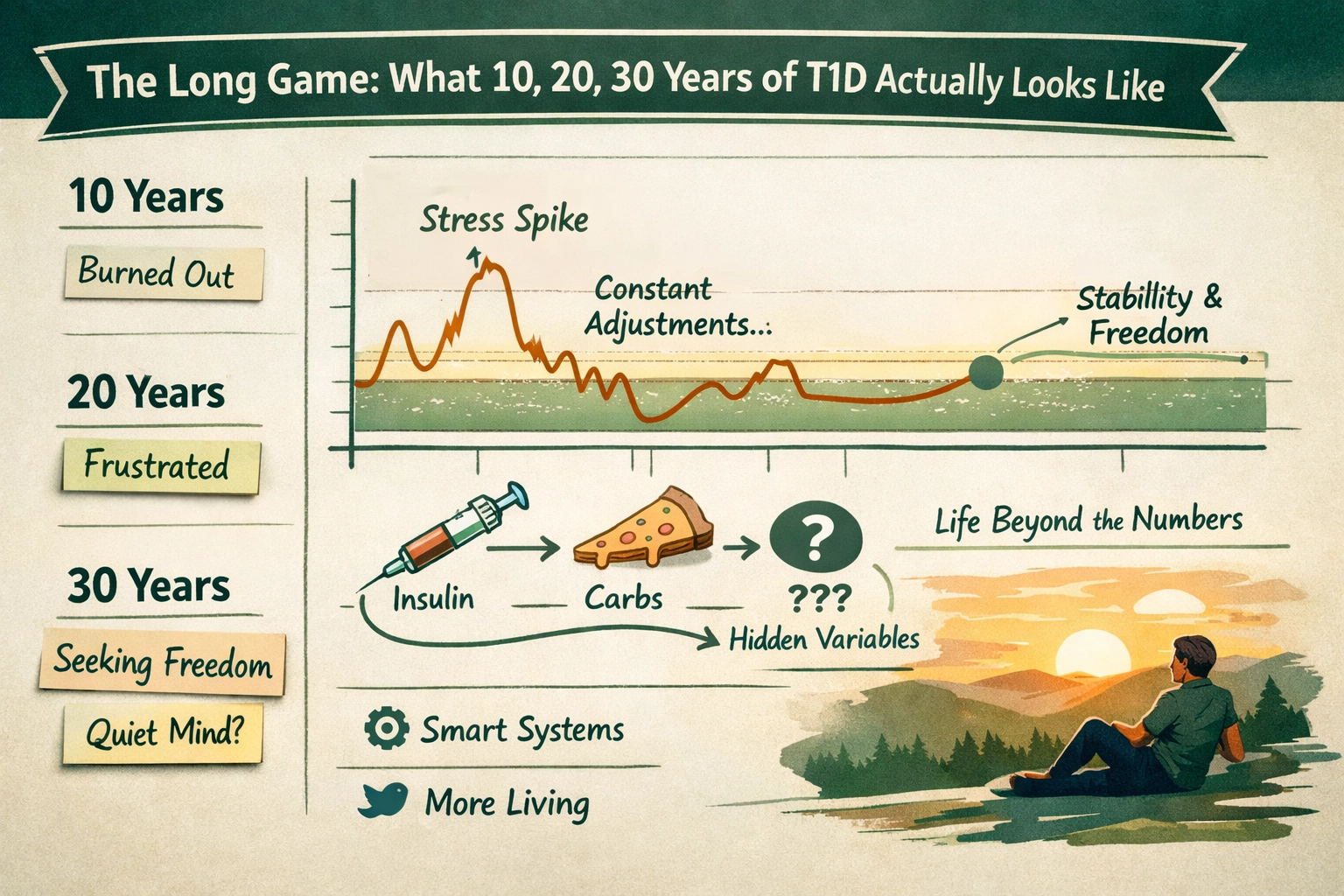
At 18 years in, I’ve made roughly 1.1 million diabetes-related decisions. I’ve gone from manual finger sticks and NPH insulin to continuous glucose monitors (CGMs) and automated pumps. I’ve lived through the "honeymoon phase," the deep burnout of my early 20s, and the eventual realization that T1D isn't a math problem you "solve": it’s a long game you learn to play.
If you’ve just been diagnosed, or if you’re five years in and feeling the weight of the "forever-ness" of this condition, this is for you. This is what the long-term T1D management reality actually looks like, based on the data and the dirt under my fingernails.
When you hit a decade with Type 1, something shifts. The novelty is long gone. The habits are baked in. But this is also the window where clinical researchers start looking for the first signs of long-term wear and tear.
Statistically, around the 10-year mark, eye complications (retinopathy) can begin to emerge in a subset of us. In the landmark DCCT study, about 16% of participants showed some level of background retinopathy after a decade.
It sounds scary. But here is the Engineer’s perspective: intensive therapy: keeping your Time in Range (TIR) high and your A1C stable: reduces that risk by nearly 50%.
At 10 years, your kidneys are usually still champions. Renal survival is almost 100% at this stage. The goal of this first decade isn't perfection; it’s establishing a foundation. It’s about learning that a high reading isn't a moral failure: it’s just data that requires an adjustment.
I’m approaching this milestone myself. By 20 years, the cumulative incidence of complications historically started to climb. But we aren’t living in the 1990s anymore.
The old textbooks will tell you that after 20 years, 50% of people had proliferative retinopathy and 35% had kidney issues. But those numbers are based on people who didn't have the tools we have today. With modern intensive management, those rates have plummeted. Proliferative retinopathy has dropped to 30%, and nephropathy (kidney disease) has fallen to around 12%.
The Veteran reality: At 20 years, you realize that your body has a "metabolic memory."
Research from the EDIC follow-up study shows that the effort you put in early on continues to protect your heart and blood vessels decades later. Even if you have a rough year or a bout of burnout, that early "banked" control keeps working for you.
This is the phase where you stop fighting the technology and start demanding it works for you. You realize that "trying harder" isn't a sustainable strategy for another 20 years. You need systems. You need automation.
Living with T1D for 30 or 40 years is a feat of endurance. By this point, you’ve likely seen it all. You’ve seen insulin brands come and go. You’ve seen the "cure is five years away" headline at least six times.
At 30 years, the focus shifts heavily toward cardiovascular health and autonomic nerve function. This is where "living fully" means being proactive. It’s about blood pressure, cholesterol, and regular screenings.
But there’s also a unique psychological strength that comes with three decades of T1D. You develop a level of intuition that no algorithm can match. You can feel a "120 and dropping" before the CGM even alerts. You become a master of your own biology.

While the clinical data focuses on eyes and kidneys, the Veteran knows the real challenge is the cognitive load.
T1D is a 24/7 job with no holidays, no sick days, and a boss (your pancreas) who quit without notice. We make roughly 180 decisions every single day that someone with a working pancreas never thinks about:
This mental exhaustion is why diabetes burnout is a clinical phenomenon. 79% of us will experience it. It’s not because we are "non-compliant." It’s because we are tired.
Caring so hard for so long is depleting. If you are in a season of burnout right now, hear me: You haven't failed. You’re just out of fuel. The long game requires knowing when to lower the bar so you don't break.
We have to talk about the elephant in the room: the fear of complications.
For years, doctors used "The Complications Talk" as a way to scare us into "compliance." It didn't work. It just created a generation of T1D adults with medical trauma and anxiety.
Let’s look at the actual math instead of the fear-mongering. Complications are not an inevitability; they are a risk factor that we can actively influence.
The fear doesn't have to be the driver. Let the data be the driver. When you understand the "why" behind your numbers, the "what if" starts to lose its power.

I didn't start Subseven because I love apps. I started it because I was tired of the guessing.
After 18 years, I realized that the "Invisible Load" was the biggest barrier to my long-term health. If I could take the 180 decisions a day and turn them into 20, I could reclaim my mental health. If I could find the patterns in my data without staring at a spreadsheet for hours, I could stay in range without the stress.
The Visionary perspective is this: Technology should give us our lives back, not just keep us alive. We are moving toward a world where diabetes lives in the background, managed by smart systems that understand our specific biology.
If you’re 20 years into this, you aren't just a "patient." You are a logistics expert, a data analyst, and a professional athlete of the mundane.
T1D is part of who I am, but it isn’t a limitation. It’s a context. It has taught me resilience that most people never have to develop. It has given me a community of some of the smartest, toughest people I’ve ever met.
The goal was never to be "perfect." My charts still have spikes. I still have days where I miscalculate a bowl of pasta and end up at 300. But the goal is to never give up. To keep showing up, day after day, year after year.
18 years in, I’m healthier than I was at year five. The tech is better. My understanding is deeper. And I’m more hopeful about the next 20 years than I ever was about the first 20.
We’re playing the long game together. Don't worry about the next decade today. Just focus on the next bolus. The rest will follow.
If you’re looking for a way to reduce that mental load and start seeing the patterns in your own data, you can learn more about our story here. We’re building the tools I wish I had 18 years ago.
You've got this. We've got this. One decision at a time.


