


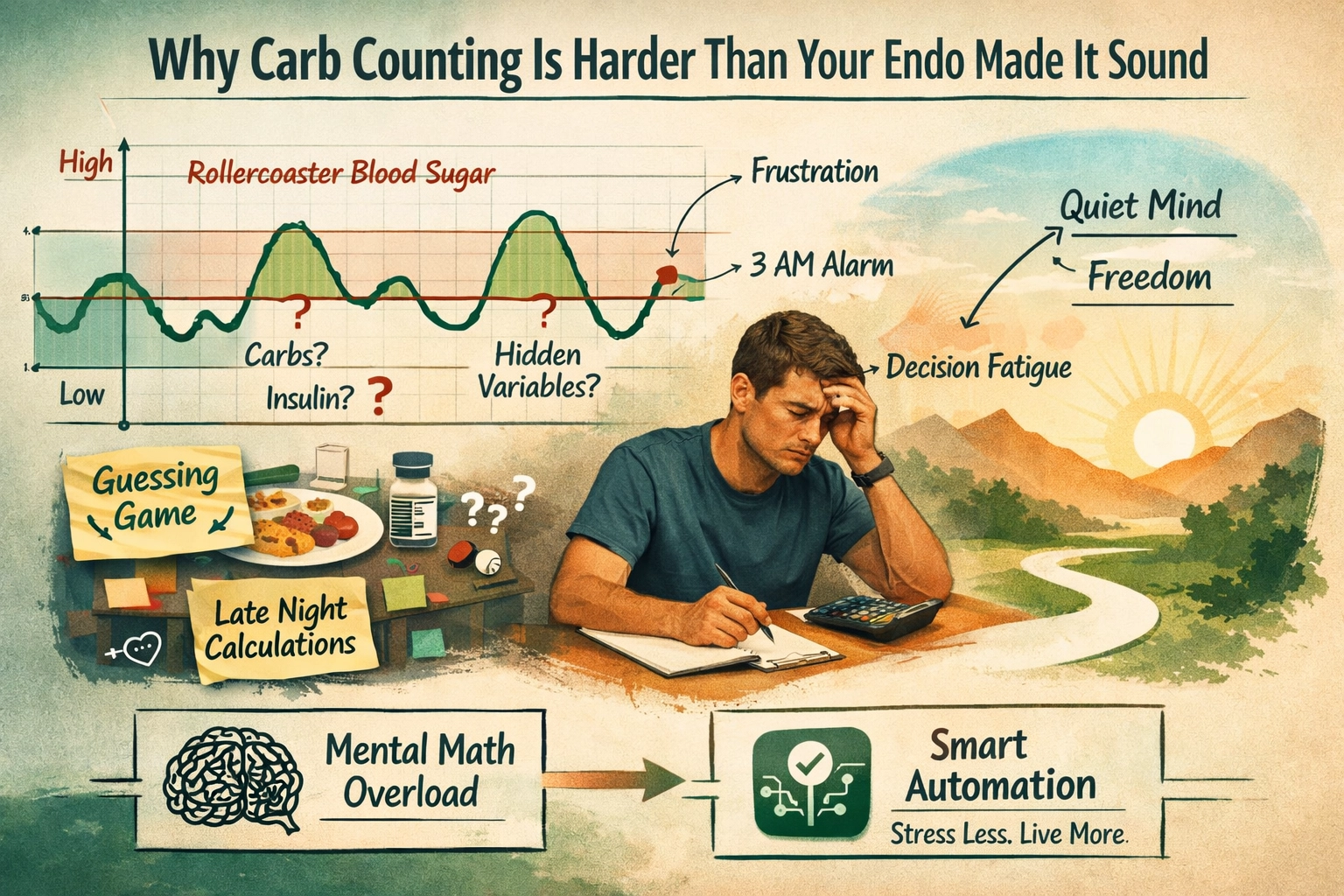
If you’re frustrated because your post-meal numbers look like a heart rate monitor at a horror movie, it’s not because you can’t add.
Your endocrinologist likely told you that carb counting is a simple math equation: Count the grams. Divide by your ratio. Deliver the insulin.
It sounds like a first-grade arithmetic problem. But in the real world, it’s closer to solving for X in a room where the ceiling is leaking, the lights are flickering, and the variables are actively lying to you.
The reality? Carb counting is one of the most difficult, imprecise, and cognitively draining parts of living with Type 1 Diabetes. Research shows that even the most diligent T1Ds have an average margin of error of about 21% in their calculations.
If you’re 21% off on a 60g carb meal, that’s 12 grams. Depending on your sensitivity, that’s enough to send you into a "rage-bolus" spiral or a 3 AM floor-juice emergency.
You aren't failing at the math. The math is failing you.
We treat nutrition labels like they are handed down on stone tablets. They aren't.
The FDA allows a 20% margin of error on nutrition labels. Think about that for a second. If a "single-serve" bag of chips says it has 30g of carbs, it could actually have 36g or 24g, and it’s still perfectly legal to sell.
Now, take that label and bring it to a restaurant.
When you look at the "official" nutrition guide for a chain restaurant, you’re looking at a laboratory version of that meal. In the actual kitchen, the line cook isn't using a scale. They are using a handful. They are using a "scoop." One extra tablespoon of a sugar-based glaze or a slightly larger potato can swing your carb count by 15–20 grams instantly.
This is the "Invisible Load." You are forced to act as a forensic nutritionist for every meal you didn't cook yourself. It’s exhausting, and it’s why "eating out" often feels more like a medical experiment than a social event.

In the T1D world, volume is the enemy of precision.
Your doctor might say, "Eat a cup of rice." But a cup of rice is not a fixed unit of glucose.
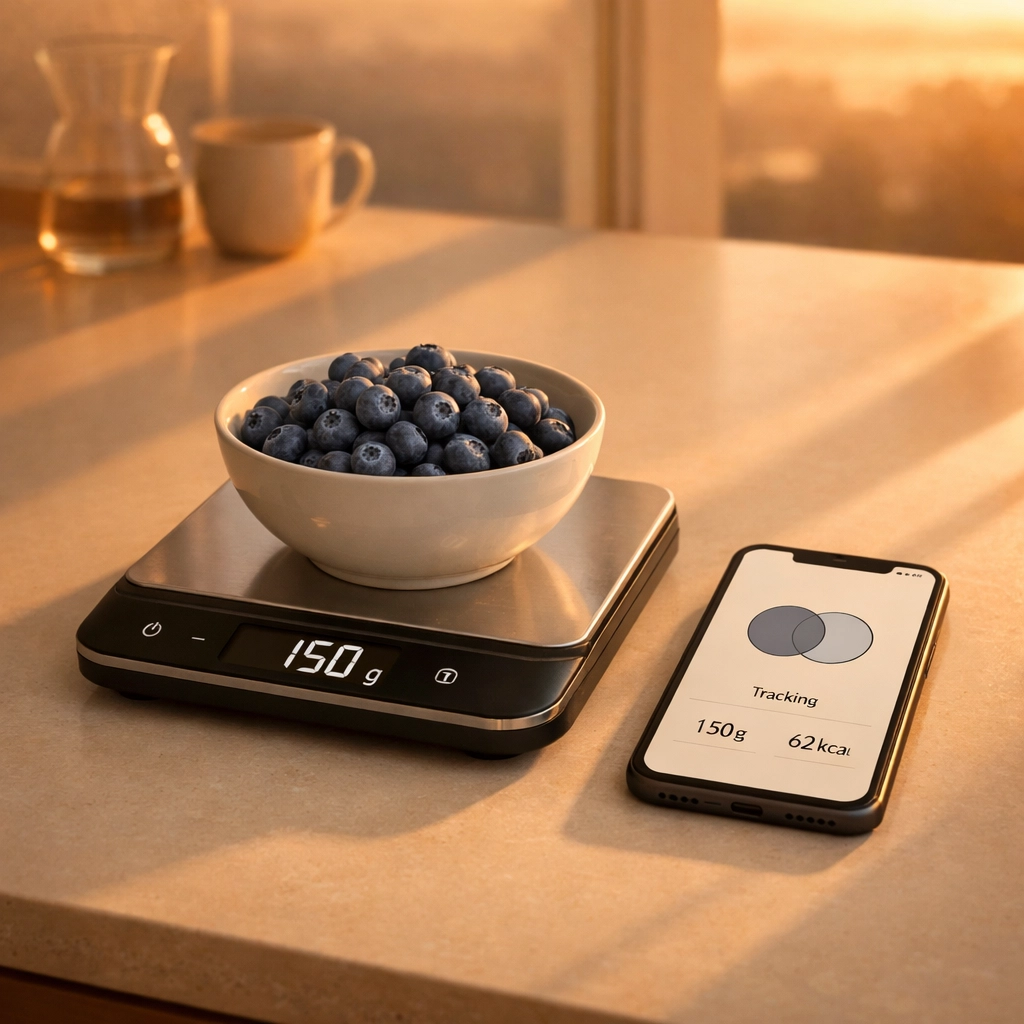
If you measure by volume (cups and spoons), you are guessing. If you measure by weight (grams), you are calculating.
A digital food scale is the only tool that actually reduces the "guessing" part of the "stressing and guessing" cycle. But even with a scale, you run into the next wall: The Biological Variable.
Let’s talk about the math that happens after the swallow.
50 grams of white rice and 50 grams of lentils have the exact same number of carbohydrates. If you use the same insulin-to-carb ratio for both, one of them is going to ruin your afternoon.
This is where the Glycemic Index (GI) comes in. White rice is a high-speed projectile of glucose. It hits your bloodstream before your rapid-acting insulin has even put its shoes on. Lentils, on the other hand, are a slow burn.
If you bolus the same way for both, you’ll spike to 250 on the rice before the insulin catches up. On the lentils, you might go low 45 minutes after eating because the insulin peaked while the lentils were still hanging out in your stomach.
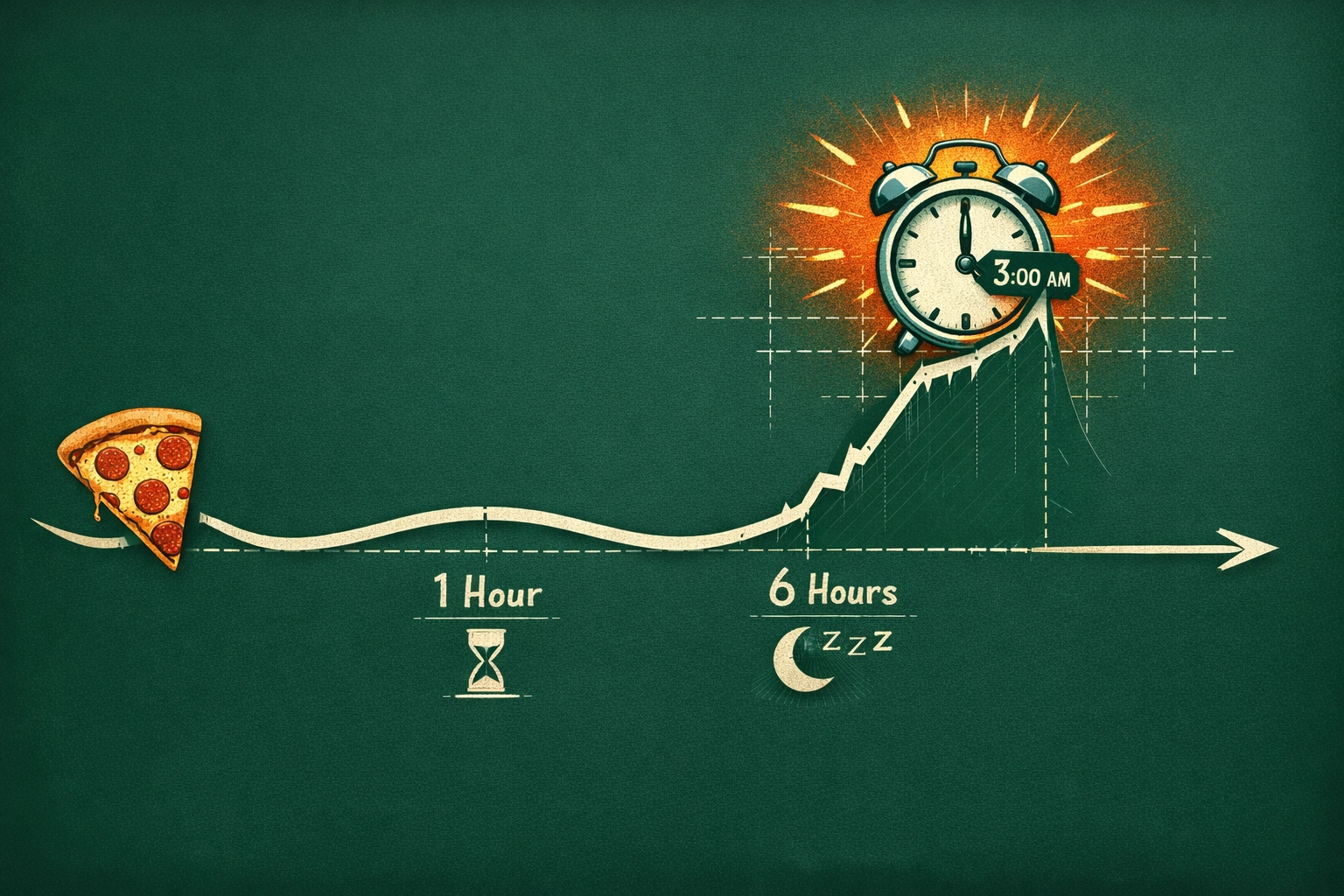
Then there’s the "Pizza Effect", the unholy alliance of fat and protein.
When you eat a high-fat, high-protein meal (pizza, tacos, burgers), the fat slows down gastric emptying. This means the carbs you counted aren't hitting your blood all at once. They are trickling in over 4 to 6 hours.
Worse, high amounts of protein can actually be converted into glucose via gluconeogenesis, and high fat causes temporary insulin resistance.
Your endo didn't give you a "fat/protein ratio," did they? Probably not. But your body sure has one. This is why you can count every single carb in a slice of pizza, dose perfectly, and still wake up at 240 mg/dL five hours later.
The "Engineer" in you wants a formula for this. The "Veteran" in you knows it’s a moving target.

There is a reason why 66% of people with T1D find carb counting "challenging" or even unsustainable.
It’s the cognitive load.
To count carbs accurately, you have to:
Now do that 3 to 5 times a day, every day, for the rest of your life.
Eventually, "decision fatigue" sets in. You start "guesstimating." You start "eyeballing." And when the numbers go sideways, the guilt sets in. You feel like you’re "bad at diabetes."
You aren't bad at diabetes. You’re human, and you’re trying to do the work of a biological organ with a plastic calculator and flawed data.
If the goal is to take the "stressing and guessing" out of the equation, we have to stop aiming for 100% precision. It’s a phantom. Instead, we aim for better systems.
1. Use a Scale (At Home)
Stop using measuring cups. Weighing your food in grams is faster and 10x more accurate. Once you see what 50g of a sweet potato actually looks like on a scale, your "eyeballing" skills at restaurants will naturally improve.
2. The Power of "The Usual"
Most of us eat the same 10–15 meals on a loop. Stop recalculating them every time. Log them once, figure out the timing that works, and turn it into a preset. Subseven is built around this idea: remembering the patterns so you don't have to.
3. Master the Pre-Bolus
Timing is often more important than the count. Getting your insulin moving 15–20 minutes before the carbs hit can cover a lot of "counting errors."
4. Use Better Databases
Ditch the generic "Google" search for carbs. Use apps like Cronometer or specialized T1D databases that break down fiber (so you can calculate net carbs) and show you the fat/protein content.
At Subseven, we believe that you shouldn't have to be a human spreadsheet just to eat a sandwich.
The future of diabetes management isn't just about better insulin; it’s about better insight. When you log your meals and your doses, the goal isn't just to look at a history log. It’s to find the patterns.
By identifying these "hidden variables," we move away from the stress of manual counting and toward the freedom of pattern recognition.
You aren't "non-compliant" because your carb counts are off. You’re navigating a complex biological system with tools that are finally starting to catch up to your reality.
Stop beating yourself up over a 20-gram discrepancy. Start looking at the trends, simplify your measurements where you can, and use tools that do the heavy lifting for you.
The goal isn't just a flat line on your CGM: it’s the mental space to think about something other than your pancreas for five minutes.
You're not failing at carb counting. Carb counting is hard. Your ratio alone will never be the whole answer, and that’s okay. You’re managing a condition that requires 180+ decisions a day; give yourself the credit you deserve for showing up to make the next one.


