


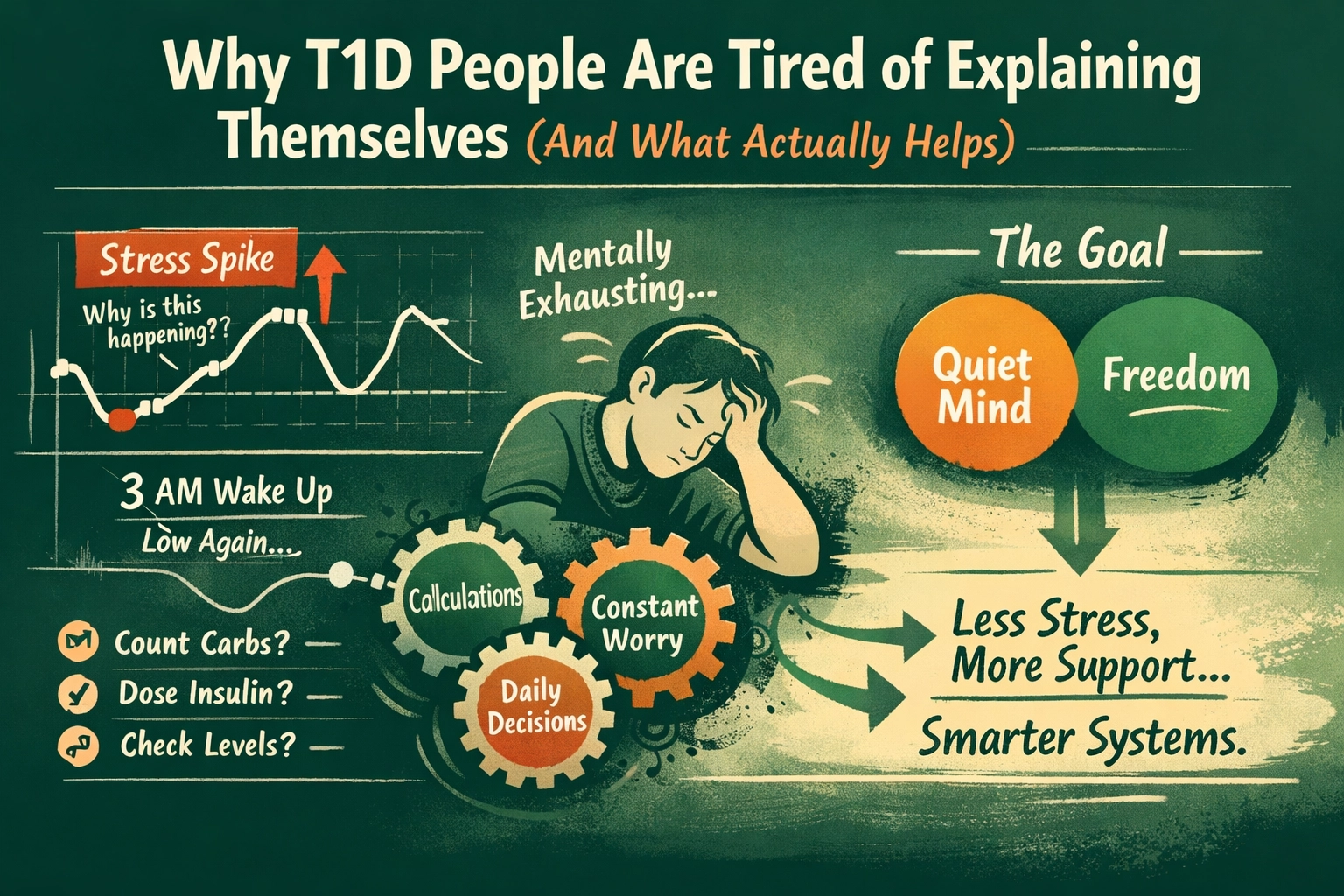
BLUF: Why are we so tired of explaining ourselves? Because Type 1 Diabetes isn't a "sugar allergy", it’s a 24/7 manual override of a failed organ. Every time we have to explain that "yes, we can eat that" or "no, cinnamon won't fix this," we are burning through a limited supply of mental bandwidth. What we actually need from the people in our lives isn't medical advice or pity; it’s presence, basic understanding, and the space to be a person first and a patient second.
You’re at a restaurant. You’ve already done the mental gymnastics of estimating the carbs in a sourdough roll, accounted for the fat in the steak that will hit your bloodstream four hours from now, and checked your CGM to see if you’re trending up or down. You’ve just clicked your insulin pen or tapped your pump.
Then, it happens. A friend, well-meaning, kind, but totally uninformed, watches you and asks, "Oh, wait, should you be eating that? I thought you couldn't have sugar."
In that split second, you have to make a choice. Do you give the "T1D vs. T2D" 101 lecture? Do you explain the mechanics of insulin-to-carb ratios? Or do you just sigh, say "It's fine," and try to enjoy a meal that already feels like a science experiment?
This is the hidden tax of Type 1 Diabetes. It’s not just the needles or the sensors; it’s the constant, grinding weight of being a T1D ambassador to a world that doesn't get it.
If you feel like you’re constantly hitting a wall of fatigue, you aren’t imagining it. Research shows that chronic fatigue affects roughly 40% of people with T1D, compared to only 7% of the general population. While we often blame high or low blood sugars for this, the reality is often "decision fatigue."
We make roughly 180 to 300 diabetes-related decisions every single day. Every. Single. Day.
When a "muggle" (our term for the non-diabetic world) asks us to explain our condition, they are asking us to perform even more labor. It’s like being a pilot of a plane where the autopilot is broken, and while you're sweating to keep the wings level, a passenger leans into the cockpit to ask how engines work.
It’s exhausting because it forces us to step out of "living life" and back into "managing a disease." We just want to eat the pizza. We don’t want to be the "Pizza Educator."

The frustration usually stems from a few persistent myths that seem to follow us everywhere. When these come up, it feels like we’re fighting a losing battle against Google University.
These misunderstandings aren't just annoying; they're isolating. They remind us that the people around us don't see the complexity of the invisible load we carry.
We call T1D an invisible illness for a reason. On the outside, we look fine. We go to work, we hit the gym, we raise kids. But beneath the surface, there is a constant, high-stakes biological dance happening.
When someone says, "But you look so healthy, you must have it under control," it can feel like they’re minimizing the struggle. It’s like looking at a swan on a lake. It looks graceful and still, but under the water, its feet are paddling like crazy just to stay afloat.
Validation is better than a compliment. We don't need to be told we look "normal." We need to be acknowledged for the incredible amount of work it takes to act normal while our internal chemistry is trying to set the house on fire.

If you’re reading this because you love someone with T1D, thank you. You’re already doing the work. If you have T1D and want to send this to someone, here is the "cheat sheet" for what actually helps:
At the end of the day, we can't change the fact that T1D is misunderstood by the masses. But we can change how much of our energy we give away.
Part of the mission at Subseven is to reduce that cognitive load. We believe that the more we can automate the "guessing" and "stressing," the more mental space we have left for the things that actually matter: like enjoying that sourdough roll without feeling like we need to give a PowerPoint presentation on it.
By using data to find patterns, we stop feeling like we’re failing and start seeing the "hidden variables" for what they are: just more data points. When we understand our own patterns, we don't feel the need to explain ourselves to others as much. We have the confidence of the Engineer and the resilience of the Veteran.
If you’re tired of the "explanation tax," take a breath. You aren't failing. This is just a really hard job that you didn't apply for. You're allowed to be tired. You're also allowed to just point people toward a resource like this and go back to living your life.

Because we've usually spent the last 20 minutes calculating exactly how to eat that food. Being questioned makes it feel like our hard work is being scrutinized or judged, rather than supported.
No. Type 1 is an autoimmune disease where the body’s immune system attacks the insulin-producing cells in the pancreas. It has nothing to do with diet or lifestyle choices.
Never do this. If they are acting weird, they might be "low" (hypoglycemic), and giving them insulin would be life-threatening. Always check their sugar or give them fast-acting glucose (juice, glucose tabs) if you aren't sure.
Research suggests between 180 and 300 decisions daily. This includes adjustments for stress, exercise, sleep, hormones, and every gram of carbohydrates consumed.
It’s a state of physical and mental exhaustion from the relentless nature of T1D management. It’s not a choice or a failure; it’s a natural response to a 24/7 high-stakes workload.
No. While exercise is healthy and can help with insulin sensitivity, it can also cause dangerous blood sugar spikes or drops, making management even more complex for a person with T1D.
About the Author:
Chris Putsch is the founder of Subseven and has lived with Type 1 Diabetes for years. He built Subseven to solve his own "stressing and guessing" and to help the T1D community reclaim the mental bandwidth lost to the 180-decision day. He believes that with the right tools, T1D can move from a constant explanation to a background process.
Want to spend less time explaining and more time living? Check out how Subseven handles the variables for you.


